
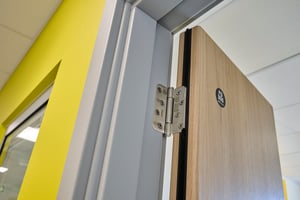
When a doorset package causes trouble on a healthcare project, it is rarely the doorset. It is a dimension nobody surveyed, an ironmongery schedule nobody owned, a certification question raised at point of sign-off, that should have been raised at design stage, or a delivery date that was always optimistic.
None of those are manufacturing problems. They are all support problems, which is why the useful question to ask a doorset supplier is not what they make, but what they do between the first drawing and the last door hung.
At specification stage, where most of the risk is created.
Almost all the difficulty in a doorset package is built in before anything is manufactured. Getting a supplier involved early means configurations, sizes and ironmongery can be resolved while they are still drawings; the certification evidence can be checked against what is actually being specified rather than something broadly similar; and the awkward areas — shielded rooms, non-standard sizes, integrated features such as vision panels or warning lights — can be identified while there is still time to do something about them.
We would always rather look at a doorset schedule at design stage than price one at tender. It produces a better specification, and a much shorter conversation later.
Through survey, drawings and sign-off.
In refurbishment work, structural openings are rarely quite where the drawings say they are. Surveying properly, agreeing dimensions and getting drawings approved before production starts is unglamorous work, and it is where programmes are protected.
It is also why a clear production sign-off matters — a single point at which the information needed to manufacture is complete and agreed. Without one, a programme is built on an estimate. With one, everything after it is predictable.
Delivery into a working building.
Deliveries into a live hospital are not ordinary deliveries. Access is restricted, storage space is limited, working hours may be constrained, and the clinical areas around the works do not stop for the programme.
Sequencing deliveries to suit the site rather than the factory, and turning up when something needs resolving, is the difference between a package that lands quietly and one that generates a fortnight of emails.
Why lead times matter, and how.
Lead time matters, though not quite in the way tender documents imply. A long lead time removes float, which means every one of the problems above becomes a programme event rather than something absorbed quietly. A short one gives a project room to change its mind — and healthcare projects do change their minds, because clinical requirements move and equipment decisions land late.
SDS’s lead times.
Six weeks from production sign-off to delivery. The clock starts when dimensions, configurations, ironmongery and finishes are agreed and the drawings are approved, which is why the work described above matters so much: the manufacturing commitment is short and known, and the design resolution before it is the part worth investing in.
On lead-lined doorsets that six weeks is subject to material availability and to the specification itself, though in most cases the same programme is achievable.
If you have a healthcare project coming up — new build or refurbishment, at any stage from concept through to tender — we would be glad to talk it through. Early is better than late, and there is no obligation attached to a conversation.