
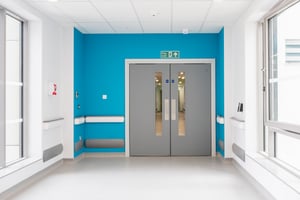
Ask where the carbon sits in a doorset and the answer is not where most people look. A door has no running cost, no energy demand and no maintenance load worth measuring. Almost all of its carbon is embodied — in the materials, the manufacture and the transport — and all of it is spent before the door is ever used.
Which leads somewhere that sounds obvious and is routinely ignored at specification stage: the most effective way to reduce the carbon in a doorset is to specify it once.
Service life is the number that matters.
A doorset that lasts the life of the building carries its embodied carbon once. One that fails at year five carries it twice, or three times. No improvement in manufacturing efficiency comes close to the saving available from simply not replacing something.
That makes service life the most useful sustainability figure in a doorset decision. It is also the one least often asked for.
In a hospital, the arithmetic is sharper.
Replacement in a healthcare building is never only a product cost. Replacing a doorset in a working ward or an occupied theatre suite means taking the space out of clinical use — lists moved, capacity borrowed from elsewhere, a room unavailable while the work happens.
So the true cost of an early replacement is measured in clinical capacity, and it falls on people who had no part in the original specification decision. A doorset chosen on capital cost can turn out to be the most expensive item in the room.
What actually determines how long a doorset lasts.
In a clinical setting, longevity is decided by construction rather than appearance, and specifically by how a doorset copes with three things: repeated impact from beds, trolleys and equipment, strict cleaning regimes using chlorine-releasing and alcohol-based agents at hospital concentrations; and other general wear and tear for repeat usage in busy traffic areas.
Two products can look identical in a brochure and at install, but differ by a decade in a corridor, so the questions worth asking are specific ones. What is the core rated to? Are the facings and edges protected as part of the construction, or applied over it? Has the facing material been tested against the cleaning agents this trust actually uses?
For our own PVC post-formed doorsets the answers are that the cores are engineered to Severe Duty rating, for impact resistance; the Dfend PVC sheet has been tested against over 280 different cleaning chemicals without degradation, cracking or delamination; and the edges are post-formed, with the PVC sheet wrapped around the leaf so there are no joints, no unprotected edges and no loose components. Both Dfendoor and Shieldoor carry a ten-year warranty.
That warranty figure is the closest thing to an honest service life indication a manufacturer can give you, and it is worth asking every supplier for it.
Why is this now a compliance question?
NHS organisations across the UK are working to 2045 Net Zero commitments that require embodied carbon to be counted rather than estimated. In Wales the public sector timetable is tighter still, which makes doorset durability an argument about meeting a target rather than simply a sensible way to spend a capital budget.
Consider the product’s environmental impact over it’s full life cycle.
An Environmental Product Declaration (EPD) is what turns all of this from an argument into a number. It is a third-party verified statement of a product’s environmental impact across defined life cycle stages, and it is what allows a doorset to be entered into a whole-life carbon assessment properly rather than approximated.
SDS can provide EPDs for both Dfendoor and Shieldoor. Alongside them, our timber is FSC® certified, our manufacturing is ISO 14001 certified, and we divert 100 per cent of our waste from landfill.
If you are preparing a carbon assessment for a healthcare scheme, or need supporting evidence against an NHS net zero reporting obligation, contact us to request a copy of the EPDs and we will send them over.
You can find out more about SDS’s sustainability commitments here.
