
What does LRV mean in healthcare design and regulations?
Light Reflectance Value (LRV) is a numerical measure (0–100) of how much visible light a surface reflects when illuminated, where 0 is near‑black, and 100 is near‑white. In healthcare design, LRV underpins visual contrast, accessibility, and compliance with the Equality Act and Building Regulations.
LRV describes how light or dark a surface appears, not just its colour name. A deep blue and a deep red may have similar LRVs even though they look different, because they reflect similar amounts of light. In practice, common finishes sit between the theoretical extremes: a typical black surface might have an LRV of 5–10%, and a brilliant white around 85%. Understanding these values matters when you are specifying doors, frames, walls, and floors for hospitals and healthcare clinics.
The regulatory driver comes from the Equality Act 2010 and the associated duty to make reasonable adjustments for disabled people. Around 95% of people registered blind still retain some residual sight, often in the form of sensitivity to contrast, light and shade rather than fine detail. For this group, good visual contrast between key elements – such as door leaves and adjacent walls, or handrails and surrounding surfaces – can be the difference between confident, independent navigation and a confusing or even unsafe journey.
Approved Document M (Volume 2) to the Building Regulations and BS 8300‑2:2018 translate this duty into practical guidance for buildings other than dwellings. They state that internal doors should be clearly distinguishable from surrounding wall and floor finishes and that a visual contrast of at least 30 LRV points between critical surfaces is generally considered adequate. The same principle applies to features like stair nosings, grab rails, and sanitary fittings.
For healthcare estates managers, architects and contractors, this means LRV is not an abstract technical metric; it is a day‑to‑day design tool. Choosing the wrong combination of colours and finishes can leave a new ward non‑compliant at handover, triggering costly rework. Choosing well can improve accessibility, reduce wayfinding queries, and support patient dignity – particularly for people with low vision, cognitive impairment or high anxiety.
Designing for 30-point contrast: doors, hardware and wayfinding.
In UK guidance, a minimum 30‑point difference in LRV between adjacent critical surfaces is widely accepted as a benchmark for visual contrast in non‑domestic buildings, including hospitals. In practical terms, that means if a corridor wall has an LRV of 70, a compliant door leaf beside it should typically fall at 40 or below, or at 100–30 = 70 and above, depending on which surface you choose to make lighter or darker.
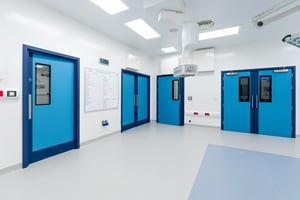
Doors and doorframes are a priority because they form decision points in the patient journey. BS 8300‑2:2018 notes that the presence of doors, whether open or closed, should be apparent to visually impaired users. One effective approach is to select a door leaf and frame that both contrast with the wall, while the frame also contrasts with the leaf. For example, a mid‑tone wall at LRV 50, a darker frame at LRV 20, and a lighter leaf at LRV 80 create a clear visual hierarchy that makes the opening easy to read at a glance.
Ironmongery needs similar attention. Door handles, push plates, and pull bars should contrast with the door face so users can quickly locate and understand how to operate them. Guidance derived from BS 8300 suggests aiming again for a 30‑point LRV difference where possible. A brushed stainless‑steel lever (often around LRV 45–55) on a deep‑coloured leaf (for example, LRV 15–20) will generally provide sufficient contrast, whereas pairing pale hardware with a very light door may not.
Using colour, light and LRV to support patient well-being.
LRV is frequently discussed in regulatory terms, but it is just as important as a tool for human‑centred healthcare design. Well‑chosen LRVs help shape spaces that feel calm, legible and safe, especially for patients experiencing pain, anxiety, or cognitive overload.
Evidence from healthcare design research shows that environmental stressors – such as glare, harsh contrast, or confusing colour schemes – can heighten pain perception and anxiety. This can lengthen procedures, increase the need for sedation, and worsen overall care experiences. Conversely, environments that balance light, colour and contrast can help shorten perceived waiting times and support smoother clinical workflows.
LRV is designed to support different patient types' well-being.
In paediatric environments, for example, patients, families and clinicians consistently highlight the value of spaces that are bright, welcoming and controllable. Colourful but carefully selected doors and frames can give children “something to look at” during tests, without introducing chaotic patterns or extreme contrasts that may overwhelm neurodivergent patients. A children’s day‑treatment centre might pair warm‑toned doors at LRVs around 50–60 with softer, lighter walls at 70–75 and quieter floors around 30–40, delivering both compliance and a friendly atmosphere.
Control over the sensory environment is also crucial. Glazed doors with integral blinds enable staff to modulate light levels quickly, supporting privacy for sensitive procedures while avoiding sudden shifts from bright corridors to dark treatment rooms. Selecting glazing, frames and surrounding finishes with appropriate LRVs reduces harsh silhouettes and helps patients with low vision interpret spaces more easily.
For older adults, people with dementia, and those with visual impairments, overly dark floors can be perceived as holes or steps, while very glossy surfaces may create confusing reflections. Choosing mid‑tone, matte finishes with LRVs that avoid extremes – for example, floors around 25–40 and walls around 60–75 – can reduce misinterpretation and the risk of falls. Handrails, bed‑head panels and nurse bases should stand out clearly against their backgrounds so patients can orient themselves and request help quickly.
In short, LRV‑informed colour strategies allow healthcare teams to create environments that are not just compliant on paper, but genuinely supportive of psychological safety, recovery and staff well‑being.
Practical steps to check LRV compliance on your next project.
Applying LRV principles consistently across healthcare projects can feel daunting, especially on complex refurbishments and phased developments. Breaking the process into a few clear steps makes it manageable and reduces the risk of late‑stage non‑compliance or expensive rework.
First, collate reliable LRV data for all proposed finishes. SDS colours publish tested LRVs for each colour or pattern. Where possible, request documentation based on recognised test methods rather than relying on subjective colour charts. For critical elements like doors and frames in high‑traffic clinical areas, consider using a dedicated LRV calculator that lets you compare values side by side and confirm that a minimum 30‑point difference is achieved.
Second, remember that projects evolve. On long programmes, substitute products or late colour changes can undermine an otherwise compliant scheme. Maintaining a simple register of LRVs for agreed finishes – and updating it whenever a change request is raised – keeps everyone aligned. Site teams can then cross‑check deliveries against the register during quality inspections.
Finally, balance LRV compliance with other clinical priorities. Doorsets and associated components must still meet demanding standards for fire resistance, smoke control and infection prevention. Choosing integrated solutions that combine certified performance with clearly documented LRVs reduces coordination and supports a smoother handover. The result is a healthcare environment where patients, visitors and staff can move safely and confidently, supported by colour and contrast choices that have been planned, not left to chance.
To find out more about how SDS can support with designing your next healthcare project, speak to one of our product specialists by contacting us via the button below.
