
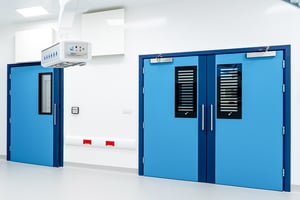
In hospital theatres, every surface counts. The door into an operating suite is not simply a barrier — it is an active participant in infection prevention and control (IPC), pressure management, staff safety, and clinical workflow. For architects, estates managers, and NHS trusts specifying these environments, one material consistently stands out: PVC post-formed doors.
Hospital theatres represent some of the most demanding environments in any healthcare building. High-frequency use, exposure to rigorous chemical cleaning regimes, strict requirements around airflow balance, and the ever-present risk of cross-contamination all place extraordinary demands on the doorsets that serve them. Getting the specification right is not just a matter of compliance — it is a matter of patient safety.
Why the theatre environment demands more.
Operating theatres sit at the top of the infection risk hierarchy within any hospital. Patients undergoing surgical procedures are among the most vulnerable to healthcare-associated infections (HCAIs), and the consequences of a breach in infection control can be severe: extended hospital stays, secondary complications, antibiotic resistance, and, in the worst cases, patient harm.
Doors in theatre environments are constantly touched by surgeons, nurses, porters, and equipment, making them significant contact points for potential pathogen transfer. The choice of material and construction is therefore critical.
This is not a decision to revisit later. Once a doorset is installed across a surgical suite, it will remain in place for many years. The cost of replacement, not just financially, but in terms of clinical disruption and infection risk from the replacement works themselves, makes it essential to get the specification right from day one.
What makes SDS post-formed doors the right choice?
Our PVC post-formed doors feature a seamless, fully wrapped surface that offers significant advantages in clinical environments. Unlike timber doors with exposed grain, joins, or laminate edges that can crack over time, post-formed construction eliminates the crevices and surface breaks where pathogens can harbour and multiply.
What specifiers should look for.
When specifying doorsets for hospital theatres, the following criteria should be central to the decision:
Conclusion.
The operating theatre is one of the most clinically demanding environments a doorset will ever face. The case for PVC post-formed doors in this setting is not simply a matter of preference; it is rooted in patient safety, clinical evidence, and the practical realities of maintaining a surgical facility over decades of intensive use.
Infection control cannot be retrofitted. It must be designed in from the outset, and the doorset is a central part of that design conversation. Specifying a post-formed PVC doorset that meets the full clinical, compliance, and durability requirements of a theatre environment is one of the most impactful decisions an architect or estates manager can make — and one that will protect patients, staff, and budgets for the life of the building.
To find out more about how SDS can support with designing your next healthcare project, speak to one of our product specialists by contacting us via the button below.
Download the IPC Breakfast Forum Summary.
In case you missed it, please download a a summary paper from our 2026 IPC Breakfast Forum which includes key discussions around IPC design considerations and recommendations.